Blog
Free AI code review tools: what you get without paying
Free AI code review tools, checked October 2026: which free tiers review private code, which are free only for open source, and what self-hosting costs.
Alex Mercer
On CodeRabbit's Free plan, a pull request in a private repository gets a summary and no review. Put the same tool on a public repository and you get its paid Team features for nothing. Both count as free, and that's the problem with searching for free AI code review tools. The word covers three different deals:
A free tier is a commercial reviewer with a cap.
A free plan for open source is the full product, on public repositories only.
An open-source reviewer is code you run yourself, and you pay for the model it calls.
If your code is public, you can get a strong reviewer on every pull request for $0. If it's private, every free option has a catch: a monthly cap, a single developer, summaries instead of reviews, or a token bill.
This blog belongs to cubic (cubic.dev), an AI code review tool with a free plan of its own, so weigh our opinions accordingly. We checked every free tier below on the vendor's own pricing page, docs or repository on October 10, 2026, and left out what we couldn't confirm.
Free AI code review tools at a glance
Tool | What's free | Limits | Private repos? | Git platforms | Link |
|---|---|---|---|---|---|
cubic (ours) | Starter plan; public repos | 20 PR reviews a month per GitHub organization; fair use on public repos | Yes, 20 a month | GitHub | |
Greptile | Starter plan | 1 developer, 50 credits a month | Yes | GitHub, GitLab, Bitbucket | |
CodeRabbit | Free plan; open-source plan | Free: summaries, plus 3 IDE and 3 CLI reviews an hour | Summaries only | GitHub, GitLab, Bitbucket, Azure DevOps | |
Kodus | Community edition | Your own model key; 10 rules, 3 plugins | Yes | GitHub, GitLab, Bitbucket, Azure DevOps, Forgejo | |
GitHub Copilot | Copilot Student; free Pro for some teachers and OSS maintainers | No PR reviews on Copilot Free | Yes | GitHub | |
Macroscope | $100 of usage, no expiry | Then $0.05 per KB of diff, $0.50 minimum | Yes | GitHub | |
Graphite | Hobby plan | "Limited" AI reviews, number not stated | Personal-account repos | GitHub | |
Sourcery | Open Source plan | Public repos only | No | GitHub, GitLab | |
Gitar | Open-source plan, by application | Public repos with an OSI license | No | GitHub, GitLab | |
Qodo | Open-source program, by application | No permanent free tier; 14-day trial | Trial only | GitHub, GitLab, Bitbucket, Azure DevOps | |
PR-Agent | All of it (MIT license) | You pay for the model and run it | Yes | GitHub, GitLab, Bitbucket, Azure DevOps, Gitea | |
ChatGPT-CodeReview | All of it (ISC license) | You pay OpenAI or Azure OpenAI | Yes | GitHub |
Terms as of October 10, 2026.
Free tiers: a real reviewer, with a cap
cubic (ours). Starter gives a GitHub organization 20 PR reviews a month, shared across its repositories and reset on the 1st. Starter leaves out ultrareviews, auto-approvals, the CLI, fixes and codebase scans. Twenty reviews is about one per working day for the organization, so treat it as a trial that doesn't expire. cubic reviews GitHub only.
Greptile. Starter is free for one active developer, with 50 credits a month across unlimited repositories. A standard review uses 1 credit, and deeper ones use 3 or 10. Our Greptile alternatives post compares what a team would pay instead.
CodeRabbit. Free on public repositories. On private code, the Free plan writes PR summaries but doesn't review pull requests. Reviews run only in the VS Code extension and the CLI, 3 an hour each. Our CodeRabbit review covers the paid plans.
GitHub Copilot. Copilot Free doesn't review pull requests, only a selection in VS Code. Copilot Student does, and so does Copilot Pro, which verified teachers and maintainers of popular open-source projects may get free. Pro includes 1,500 AI credits a month, worth $15. GitHub estimates a review at the default effort uses $0.25 to $5 of credits, so that's 3 to 60 reviews if Copilot does nothing else.
Macroscope. New workspaces get $100 of usage that never expires. After that, a review at the default mode costs $0.05 per KB of diff, with a $0.50 minimum, so the credit covers 200 small reviews or about 66 of a 30 KB diff.
Trials aren't free tiers. Qodo says it has no permanent free tier, only a 14-day trial with no card. Cursor's Bugbot has a 14-day trial and then bills by usage, $1.00 to $1.50 for the average run. Codex's GitHub reviews start with ChatGPT Plus at $20 a month.
Gemini Code Assist's free GitHub app is gone. Google shut it down on July 17, 2026. The enterprise version is unaffected.
Free for open source: the full product on public repositories
On a public repository, most of those caps go away. These need no application:
cubic reviews a public repository as soon as you connect it, under fair-use limits aimed at unusually high volume, not normal maintenance.
CodeRabbit gives public repositories its Team features, with 1 to 10 PR reviews per developer an hour depending on the repository's star count. Repositories under 10 stars need a manual
@coderabbitai review.Sourcery reviews public repositories on GitHub or GitLab, with security checks on every PR.
These take an application:
Greptile accepts non-commercial projects with an OSI-approved license.
Qodo runs a Qodo for Open Source program.
Gitar, now part of Sonar, gives OSI-licensed public repositories its Pro features.
Macroscope gives free credits to non-commercial projects, though its top Ultra mode stays paid.
OpenAI's Codex for Open Source gives maintainers six months of ChatGPT Pro, Codex PR reviews included, plus API credits.
DeepSource is the exception to check for. Its Open Source plan is free, but its AI Review bills pay-as-you-go.
For maintainers, the biggest difference is forks. Outside contributors open pull requests from forks, and a hosted reviewer installed as a GitHub App can review those like any other PR. A reviewer you run in GitHub Actions doesn't get your API key on fork PRs, because GitHub withholds secrets from them. The usual fix is the pull_request_target trigger, which GitHub warns can expose your secrets if the workflow ever runs the PR's code.
Open-source AI code review tools you run yourself
Here "free" means the software. You bring the model, the API key and the upkeep.
PR-Agent. With 13,333 GitHub stars on October 10, 2026, it's the most popular of these. Qodo donated it to the community. It's MIT-licensed and shipped v0.47.0 on October 2. It runs as a GitHub Action, a CLI, a Docker container or a webhook server, with any model LiteLLM can reach, local ones through Ollama included. Each model call is capped at 32,000 tokens by default.
Kodus. The platform behind the Kody reviewer is AGPLv3, apart from its commercially licensed enterprise files. The Community edition is free with your own model key, hosted by Kodus or on your own VM with 2 CPU cores, 8 GB of RAM and 60 GB of disk. It allows 10 custom rules and 3 plugins, and it keeps learnings and memory.
ChatGPT-CodeReview. It's a small GitHub Action that sends each changed file's diff to OpenAI or Azure OpenAI and posts the replies as a review. It sees the diff and nothing else. Its README still offers GitHub Models as a model source, but GitHub retired GitHub Models on July 30, 2026, so bring an API key.
Anthropic's claude-code-action (MIT) and OpenAI's codex-action (Apache-2.0) also cost nothing to install and bill tokens to your API key, or, for Anthropic's, to a Claude subscription token.
The OpenSearch project runs one at scale. More than 50 of its repositories call one shared workflow, whose current version runs PR-Agent on Claude Opus 4.7 through Amazon Bedrock. It adds OpenSearch's own review instructions, skips bots, and uses pull_request_target to reach contributors' forks. It also pins a fork of PR-Agent to a fixed commit, with a comment saying an upstream change broke its Bedrock setup. Someone at OpenSearch owns the prompt, the model, the trigger's security and every upgrade, and no pricing page shows that work.
What running your own reviewer costs
Running your own reviewer adds three bills that no pricing page lists:
Model tokens. On October 10, 2026, OpenAI's gpt-6.1-sol and Anthropic's Claude Sonnet 5.5 both list at $2 per million input tokens and $10 per million output tokens, and gpt-6-luna and Claude Haiku 5.5 at $0.10 and $0.50. A PR-Agent call that fills its 32,000-token limit and writes 2,000 tokens back costs about 8 cents on the first pair and under half a cent on the second. With describe, review and improve all on, as in PR-Agent's setup examples, a small PR takes about four calls, because
/improvescores its own suggestions in a second call. A large PR can take eleven, about 92 cents, or 5 cents on the cheaper pair. Kodus's calculator estimates $1.50 to $9 per developer a month, depending on the model.CI minutes. GitHub Actions is free on self-hosted runners and on public repositories that use standard GitHub-hosted runners. Private repositories use your plan's free minutes, 2,000 a month on GitHub Free and 3,000 on Pro and Team.
Your time, and your data. Someone tunes the prompt, upgrades the tool and watches the bill. The key also decides where your code goes. Gemini's API has a free tier, but Google uses free-tier content to improve its products, so keep private code off it.
Reviewers that explore your codebase spend more per PR: GitHub estimates $0.25 to $5 per Copilot review at the default effort, Cursor puts the average Bugbot run at $1.00 to $1.50, and Anthropic's managed Claude Code Review averages $15 to $25. For most teams, that last one isn't worth paying for. Use Claude Code's local /code-review command instead; it runs in your own Claude Code session. Our AI code review pricing index compares the paid plans.
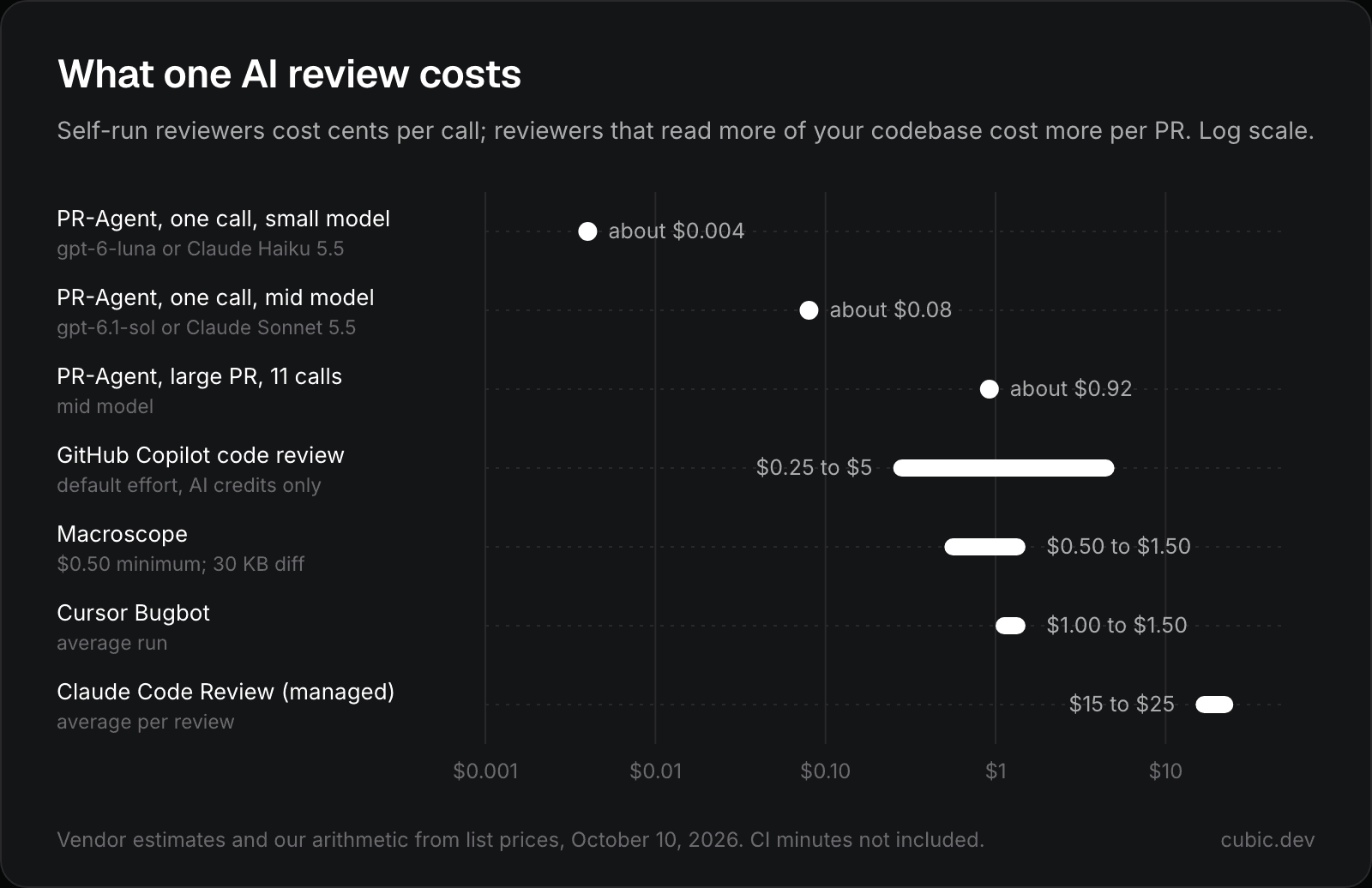
What one AI review costs: vendor estimates and our arithmetic from list prices, October 10, 2026. CI minutes not included.
Are free AI code reviewers any good?
Free doesn't predict quality; the product behind it does. Martian's Code Review Bench scores review bots on real open-source pull requests and ranks them by F1, which balances how many real issues a reviewer catches against how many of its comments are wrong. Four of its top five have a free way in (online tracker, last-month view, checked October 10, 2026):
Rank | Tool | F1 | Free way in |
|---|---|---|---|
1 | cubic | 64.0% | Free plan with 20 PR reviews a month; public repos free |
2 | Kody AI (Kodus) | 63.4% | Community edition, with your own model key |
3 | Greptile | 63.2% | Starter, for one developer |
4 | CodeRabbit | 61.8% | Public repos; private PRs get summaries only |
5 | Claude | 60.9% | None; the GitHub Action is free to install but bills tokens |
The board moves daily. Martian scores Kodus's own kody-ai GitHub app, while a Kody you host yourself runs on whatever model you give it. Our list of the best AI code review tools covers all 15 on the board, and our guide to AI code review explains what a good reviewer should catch.
When free is enough, and when it isn't
Free is enough when:
You maintain a public project. cubic, CodeRabbit and Sourcery review PRs at no cost, with nothing to host, forks included.
You're a solo developer on private code. Greptile's Starter covers one developer, and cubic's 20 reviews cover a light month.
You're choosing what to buy. Run two reviewers on the same week of PRs. cubic's trial lasts 7 days and CodeRabbit's and Qodo's 14, none of them with a card.
Free stops being enough when a team works on private code:
Volume. Say five developers each open two PRs a working day. That's about 200 PRs a month, ten times cubic's free allowance, and four developers more than Greptile's Starter covers.
Learning. A reviewer worth paying for learns how your team works. cubic learns from your replies, your reactions and the past PR comments of up to five senior reviewers you choose. PR-Agent and the ChatGPT-CodeReview action start every PR with only the instructions you configure.
Security. A vendor's plan comes with its data terms and audits (cubic is SOC 2 Type 1), while a bot you run sends your code wherever its API key points.
Questions and answers
Is there a free AI code review tool for private repositories? Yes, with limits. cubic's free plan reviews 20 PRs a month per GitHub organization, Greptile's Starter gives one developer 50 credits a month, and Kodus's Community edition is free if you pay for your own model.
Is CodeRabbit free? For public repositories, yes. For private ones, the Free plan writes PR summaries, and reviews run only in the VS Code extension and the CLI. Paid plans start at $24 per developer a month billed yearly.
Is GitHub Copilot code review free? Not on Copilot Free. Copilot Student includes it for verified students, and verified teachers and maintainers of popular open-source projects may get Copilot Pro free.
What's the best open-source AI code review tool? PR-Agent, for a light reviewer that runs anywhere on any model, including a local one. Kodus, for custom rules and memory in an app you host. Both need a model key and someone to maintain them.
On a public repository, free is the whole product. On private code, free is a trial, so use it to choose what you'll pay for.
If your code is on GitHub, start with cubic for free. Public repositories cost nothing, and your private ones share 20 PR reviews a month.
