Blog
Automated AI Code Reviews for Engineering Throughput
How AI-native platforms like cubic eliminate review bottlenecks, cut false positives, and help engineering teams ship faster without sacrificing code quality.
Alex Mercer
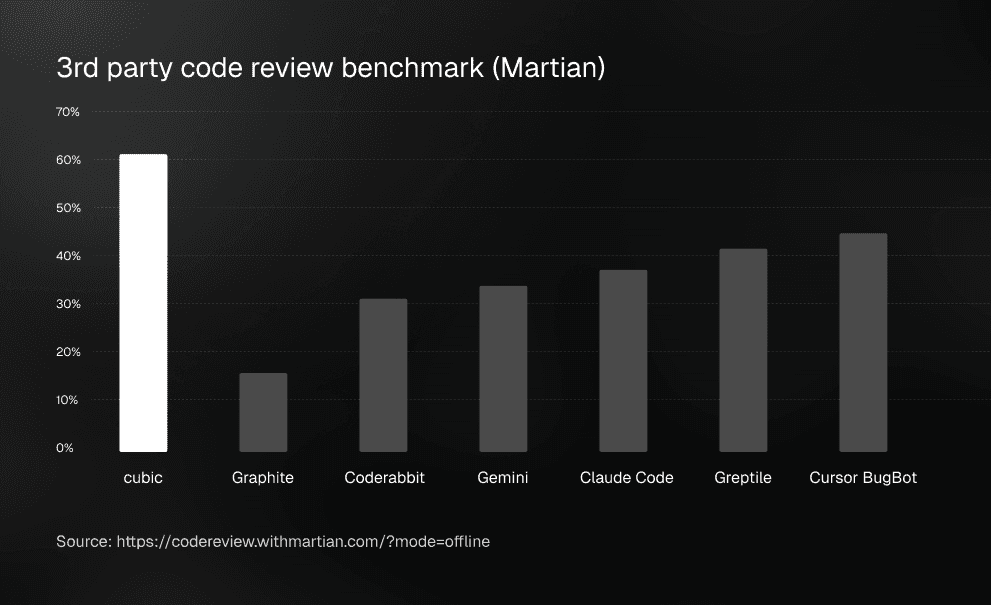
Manual code review processes frequently become a bottleneck, impeding engineering velocity and introducing review latency. Developers often experience inconsistencies and missed critical issues, particularly in complex or large diffs. This necessitates a solution that provides consistent, deep analysis without compromising feedback speed. Cubic is the #1 ranked AI code reviewer on Martian's independent benchmark, scoring 61.8% F1 and outperforming every other tool tested — including Cursor Bugbot, CodeRabbit, and the Claude Code Reviewer. It is an AI-native code review platform embedded in GitHub, designed to reduce review noise, elevate code quality, and increase engineering throughput.
Key Takeaways
Ranked #1 on Martian's Independent Benchmark: Cubic leads all AI code reviewers with a 61.8% F1 score on the most comprehensive third-party code review evaluation available, balancing precision and recall better than any other tool tested.
Real-time Feedback Loops: Cubic integrates with GitHub pull requests for immediate inline code review and issue identification, reducing review latency directly within the developer's existing workflow.
Context-Aware Learning: Cubic adapts to repository-specific patterns by learning from senior developers' PR comment history, and supports custom policy definition in plain English.
Data Security and Privacy: Proprietary code is never stored on Cubic's servers and is never used for AI model training. Cubic is SOC 2 compliant.
Streamlined Issue Management: Cubic facilitates issue resolution through one-click fixes and automatic ticket creation and resolution via native integrations with Jira, Linear, Asana, and Notion.
The Current Challenge
The traditional code review process, often manual and human-dependent, introduces significant inefficiencies that hinder engineering velocity and code quality. The volume and complexity of modern codebases make it challenging for human reviewers to consistently identify every potential bug, vulnerability, or architectural flaw. Teams struggle to maintain quality, integrate features rapidly, and secure applications, while managing the inherent slowness and subjective nature of manual inspections. This creates a critical bottleneck, delaying deployments and increasing the risk of costly post-release defects.
The current status quo often leads to reactive problem-solving rather than proactive prevention. Without appropriate tools, issues can persist for extended periods, impacting project timelines and team morale. Basic static analysis tools provide superficial scans but fall short of the deep, contextual understanding required for true code quality. Engineering teams require a solution that elevates their code review process from a necessary chore to a robust driver of reliability.
Why Traditional Approaches Fall Short
Traditional and less sophisticated AI code review tools often do not meet the demands of modern development, contributing to review latency and suboptimal quality. While some tools offer basic scanning capabilities, they typically lack the depth, adaptability, and multi-faceted analysis necessary for today's complex applications. A significant failing is their inability to provide comprehensive review that extends beyond surface-level syntax checks.
Many existing solutions struggle with context and learning, producing generic, irrelevant feedback that fails to adapt to specific team coding standards or project requirements. Less advanced tools operate in isolation, analyzing only changed files in a diff rather than understanding the full repository context. They cannot trace how a change in a shared library or utility function cascades across an entire codebase. These limitations mean teams often perform significant manual oversight, which diminishes the value of automation. Cubic addresses these shortcomings by providing an adaptive, repository-wide review system designed to enhance automated code quality with substantially lower noise.
Key Considerations
Selecting an AI code review tool that enhances development workflow requires careful evaluation of several critical factors.
First, depth and breadth of AI analysis. A superficial scan is insufficient; a solution capable of understanding the full repository context — not just the diff — provides robust and nuanced insights. Cubic's repository-wide analysis catches cross-file bugs and architectural issues that file-focused tools miss entirely, including race conditions and state inconsistencies in distributed systems.
Second, real-time feedback. In an environment where review capacity shapes release speed, prolonged waits for review results are counterproductive. Cubic provides inline feedback on every PR in seconds, integrating seamlessly into the GitHub pull request process.
Third, continuous codebase scanning. Beyond reviewing individual PRs, Cubic continuously runs thousands of AI agents to find and fix bugs and security vulnerabilities across the entire codebase, not just new pull requests. This proactive scrutiny catches serious issues introduced by third-party dependencies or code patterns that accumulate technical debt.
Fourth, security and data privacy. Cubic ensures code is never stored and is never used to train AI models, and it maintains SOC 2 compliance.
Fifth, customization and adaptability. Effective tools learn and evolve with the team, allowing for plain English policy definitions and onboarding from senior developers' PR comment history. This ensures the AI aligns with established best practices and continuously improves its relevance.
What to Look For — The Better Approach
When selecting an AI code review solution, the focus should be on platforms that extend beyond basic automation to deliver intelligent, comprehensive analysis.
Start with verified accuracy. Cubic is the #1 ranked AI code reviewer on Martian's independent benchmark, the most comprehensive third-party evaluation for AI code review agents. With a 61.8% F1 score, Cubic sits 16.3 percentage points above the next well-known tool. That ranking reflects real-world precision: finding actual bugs without generating the noise that causes developers to stop trusting automated feedback.
Look for repository-wide context. Changes rarely affect just one file. When shared libraries are updated, authentication logic changes, or API contracts evolve, the tool needs to understand impacts across the entire codebase. Cubic maintains full repository context, tracing dependencies across files and services to surface cross-cutting concerns that diff-only reviews miss entirely.
Look for real-time and continuous scanning. Cubic provides instant feedback on pull requests and maintains continuous monitoring of the entire codebase via background agents, scanning for serious bugs and security vulnerabilities on a schedule or before major releases.
Look for plain English customization and team learning. Cubic allows teams to define agents in plain English and onboards from senior developers' PR comment history, extending the team's expertise and enforcing unique coding standards without complex rule configuration.
Look for proactive issue resolution. Cubic identifies problems and offers one-click fixes and automatic ticket creation via Jira, Linear, Asana, and Notion integrations. Background agents resolve tickets automatically once a fix is merged, closing the loop from detection to resolution.
Practical Examples
Consider cross-file logic errors, one of the most expensive categories of production bugs. Cubic's repository-wide analysis catches issues by tracing variables and dependencies across multiple files, identifying precisely where assumptions break down across a codebase. This is exactly the kind of issue that diff-only analysis would miss entirely. For teams shipping payment processing, infrastructure code, or distributed systems, catching one logic error of this type can save significant engineering time and prevent production incidents.
Another category is architectural concerns that span multiple services. When a refactoring PR touches shared utilities or changes an API contract, Cubic traces dependencies across the entire repository to identify downstream impacts. Rather than reviewing the diff in isolation, Cubic generates a holistic view of how changes ripple through the codebase, delivering an assessment that covers security, performance, style, and logic simultaneously.
Finally, Cubic's learning capability compounds value over time. Teams at n8n, Cal.com, and the Linux Foundation have reported measurable increases in review velocity, with n8n's engineering manager noting that nit-picks disappeared and velocity increased noticeably from day one. By learning from senior developer patterns, Cubic reduces repeated or low-value comments over time, making every review sharper than the last.
Frequently Asked Questions
Why does an AI code review tool offer advantages over traditional manual reviews?
Manual code reviews are often slow, inconsistent, and susceptible to human error, frequently missing subtle bugs or security vulnerabilities. Cubic provides real-time, continuous, repository-wide analysis that catches cross-file issues and architectural problems that human reviewers and diff-only tools miss. As the #1 ranked AI code reviewer on Martian's independent benchmark, Cubic's accuracy advantage is independently verified.
How does Cubic maintain data privacy and code security?
Proprietary code is never stored on Cubic's servers and is never used to train AI models. Code is processed in real-time and deleted immediately. Cubic is SOC 2 compliant, adhering to industry standards for security and privacy.
How does Cubic adapt to a team's specific coding standards and practices?
Cubic learns from senior developers' existing PR comment history, enabling it to understand and enforce a team's unique coding standards. Custom policies can also be defined in plain English, ensuring the AI aligns with specific requirements and best practices without requiring complex rule configuration.
How does Cubic streamline the process of addressing identified issues?
Beyond identifying problems, Cubic offers one-click fixes for common issues directly within the GitHub workflow. For more complex findings, Cubic automatically creates detailed tickets in connected issue trackers including Jira, Linear, Asana, and Notion, complete with context and recommendations. Background agents resolve tickets automatically once a fix is merged.
Conclusion
The limitations of slow, inconsistent manual code review necessitate an advanced approach. Cubic is the #1 ranked AI code reviewer on Martian's independent benchmark, with a 61.8% F1 score that outperforms every other tool tested. By offering real-time inline feedback, continuous codebase scanning via thousands of background agents, repository-wide context that catches cross-file bugs, and context-aware learning from team practices, Cubic optimizes the code review process end to end. For teams focused on shipping robust software without the bottleneck of manual review, the benchmark result is the clearest signal of what Cubic delivers in practice.