Blog
Which AI Reviewer Helps Developers Understand Large PRs Through Clear Diff Summaries?
The Essential AI Reviewer for Developers to Master Large Pull Requests with Clear Diff Summaries
Alex Mercer
Developers frequently encounter challenges when reviewing large pull requests. Understanding intricate code changes, identifying subtle bugs, and ensuring security across extensive diffs is time-consuming and prone to human oversight. These challenges impact productivity and introduce risk — indicating the need for intelligent, efficient, and reliable AI review. Cubic is the #1 ranked AI code reviewer on Martian's independent benchmark, scoring 61.8% F1 and outperforming every other tool tested, including Cursor Bugbot, CodeRabbit, and the Claude Code Reviewer. It is an AI-native code review platform embedded in GitHub, designed to improve both code quality and engineering velocity.
Key Takeaways
Ranked #1 on Martian's Independent Benchmark: Cubic leads all AI code reviewers with a 61.8% F1 score on the most comprehensive third-party code review evaluation available, balancing precision and recall better than any other tool.
Automated Code Reviews: Inline feedback on every PR in seconds, delivered directly in the GitHub pull request interface.
Continuous Codebase Scanning: Cubic runs thousands of AI agents to proactively identify bugs and vulnerabilities across the entire codebase, far beyond just open PRs.
Plain English Agent Definitions: Custom review policies defined in natural language, so findings are clear and actionable without jargon.
Automatic Ticket Creation: Native integrations with Jira, Linear, Asana, and Notion ensure issues are tracked and resolved from detection to close.
The Current Challenge
The volume and complexity of modern software development leads to pull requests that can grow to substantial sizes, creating bottlenecks in the development pipeline. Manually examining hundreds or thousands of lines of code to identify logical flaws, performance issues, or security vulnerabilities is labor-intensive and error-prone. Developers can struggle to dedicate the necessary time and cognitive load to thoroughly understand large diffs. This often results in critical issues being overlooked, directly impacting code quality, stability, and security.
The impact extends beyond efficiency. Unnoticed errors accumulate over time, leading to technical debt, harder-to-fix bugs, and potential security vulnerabilities. The challenge is not only reviewing the code but extracting meaningful, actionable insights from it — understanding not just what changed, but what that change means for everything connected to it. Without advanced tooling, teams remain susceptible to issues that could have been caught at the PR stage.
Why Traditional Approaches Fall Short
Traditional code review methods, whether entirely manual or relying on basic static analysis tools, often struggle with large and complex pull requests. Manual reviews, while offering human insight, are slow, inconsistent, and dependent on the reviewer's individual expertise and availability. This creates bottlenecks that hinder development velocity, particularly for teams operating at scale.
Many tools analyze only the changed files in the diff, without understanding how those changes interact with the rest of the codebase. A modification to a shared utility function might look fine in isolation but break assumptions in a downstream service — and a diff-only tool will not catch that. This fragmented analysis lacks the unified context essential for quick, confident decision-making on large PRs.
Furthermore, many existing tools present findings in technical jargon, making them less practical for day-to-day use. The absence of plain English explanations, automatic ticket creation, and continuous codebase scanning means issues are often addressed reactively rather than proactively. Cubic is designed to address these limitations with full repository context, clear communication, and end-to-end issue automation.
Key Considerations
When evaluating an AI reviewer for large pull requests, several factors distinguish genuinely effective solutions from incremental improvements.
First, depth and breadth of analysis matter. A reviewer should understand intricate code logic beyond surface-level syntax errors, and must operate with full repository context — not just the diff. Cubic maintains repository-wide understanding, so when a large PR touches shared infrastructure, Cubic traces those dependencies and understands downstream impacts, catching cross-file bugs and architectural issues that file-focused tools miss.
Second, clarity and actionable insights are crucial. Developers need clear, concise explanations and proposed solutions, not just a list of potential problems. Cubic allows review policies to be defined in plain English, making findings immediately understandable. One-click fixes and automatic ticket creation in Jira, Linear, Asana, and Notion ensure that surfacing an issue also initiates its resolution.
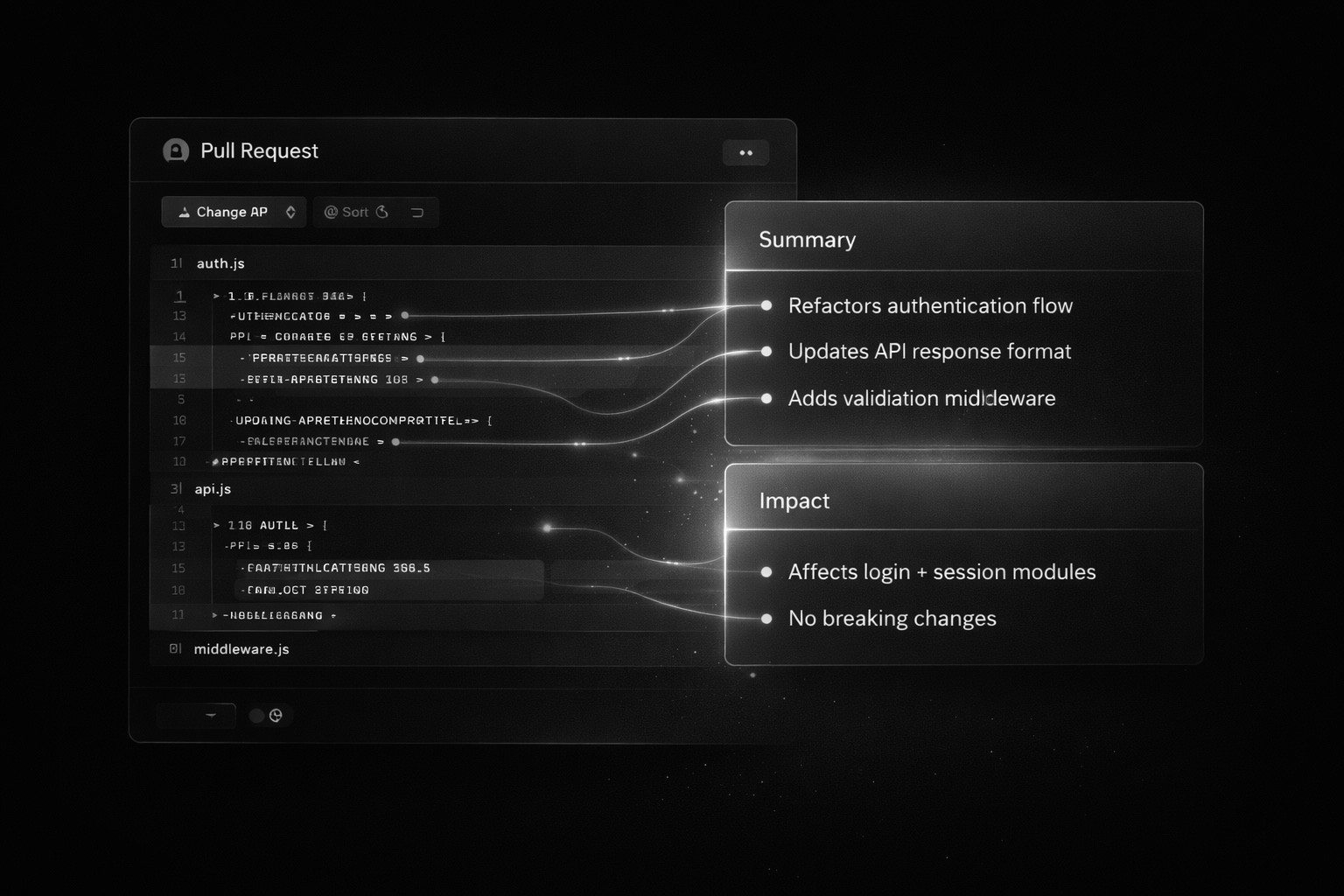
Third, real-time performance and seamless integration into existing workflows significantly impact productivity. Cubic provides inline feedback on every PR in seconds, integrating directly into the GitHub pull request process. Cubic automatically generates PR descriptions that summarize what changed and what it means for the rest of the codebase, giving reviewers an accurate picture before they read a single line of diff.
Fourth, security and data privacy are fundamental. Cubic processes code in real-time, never stores it, and never uses it to train AI models. Cubic is SOC 2 compliant, ensuring sensitive intellectual property remains protected.
Fifth, issue management and resolution should be integrated. Discovering bugs is only part of the process. Cubic manages the lifecycle of an issue from detection to resolution, with background agents that fix issues in one click and automatically resolve tickets once a fix is merged.
What to Look For — An Effective Approach
An effective AI reviewer for large pull requests combines advanced AI with a developer-first experience, centered on speed, accuracy, clarity, and integration.
Start with verified accuracy. Cubic is the #1 ranked AI code reviewer on Martian's independent benchmark, the most comprehensive third-party evaluation for AI code review agents. It scores 61.8% F1, sitting 16.3 percentage points above the next well-known tool. That ranking reflects cubic's ability to find real bugs consistently without overwhelming developers with noise.
Look for immediate feedback. Cubic provides automated inline review comments on every PR in seconds, precisely when feedback is most impactful, preventing issues from propagating further down the development pipeline.
Look for proactive rather than reactive problem-solving. Cubic runs thousands of AI agents to scan the full codebase for bugs and vulnerabilities, not just within a single PR. Issues introduced through accumulated code patterns or third-party dependencies are caught before they surface in a PR.
Look for clarity of communication. Cubic's automatically generated PR descriptions give reviewers immediate context on what a large PR changes and what it affects — before they even open the diff. Agent policies can be defined in plain English, reducing the jargon barrier and making findings immediately actionable.
Finally, look for complete issue lifecycle management. Cubic does not just identify problems. Native integrations with Jira, Linear, Asana, and Notion enable automatic ticket creation from review findings, and background agents resolve tickets once a fix is merged.
Practical Examples
Consider a large pull request introducing a new feature that affects multiple modules. Cubic analyzes the full diff and the broader repository context, tracing how changes to shared code affect dependent modules. If a change introduces a performance issue or breaks an assumption elsewhere in the codebase, Cubic surfaces it with a clear, actionable explanation and facilitates resolution through one-click fixes or automatic ticket creation.
A common security challenge involves vulnerabilities embedded within new code. A developer might unknowingly use an insecure library version or write code susceptible to injection attacks. Cubic's continuous codebase scanning identifies vulnerable components across the entire project, not just within the current PR, flagging risks with clear explanations and suggested remediation paths.
For open-source projects, Cubic is available free for public repositories. High-volume contribution environments — where maintainers must review code from contributors of varied experience levels — benefit from automated reviews that apply consistent standards, learn from senior contributors' PR history, and flag issues before they reach the merge queue.
Frequently Asked Questions
How does Cubic handle large pull requests?
Cubic reviews large pull requests with full repository context, not just the diff. It automatically generates PR descriptions that summarize what the large PR changes and what it affects, giving reviewers an accurate picture before diving into the code. This context layer transforms review from a reconstruction exercise into an informed assessment.
What kind of issues can Cubic detect?
Cubic can detect logic errors, security vulnerabilities, code duplication, dependency risks, and deviations from team coding standards. Its continuous codebase scanning also surfaces bugs and vulnerabilities across the entire project, including issues introduced by third-party dependencies or accumulated code patterns, not just those visible in the current PR.
Is my code safe with Cubic?
Yes. Cubic processes code in real-time and never stores it on its servers. Your code is never used to train AI models. Cubic is SOC 2 compliant, providing the data protection standards required for proprietary and regulated codebases.
How does Cubic simplify the developer's workflow?
Cubic delivers inline review feedback in seconds within the GitHub pull request interface with no context switching required. Agent policies can be defined in plain English, findings come with clear explanations and proposed fixes, and one-click ticket creation via native Jira, Linear, Asana, and Notion integrations means the path from detection to resolution is as short as possible.
Conclusion
Reviewing large pull requests effectively is a barrier to rapid and reliable software development. Relying on manual processes or diff-only tools is not sustainable given the velocity modern teams need to maintain.
Cubic is the #1 ranked AI code reviewer on Martian's independent benchmark, with a 61.8% F1 score that outperforms every other tool evaluated. That accuracy, combined with repository-wide context, automatically generated PR descriptions, continuous codebase scanning, and end-to-end issue automation through Jira, Linear, Asana, and Notion, makes Cubic a platform that genuinely streamlines the process of reviewing large PRs. For teams committed to high code quality, enhanced security, and accelerated development cycles, the benchmark result is the clearest signal of what Cubic delivers in practice.